

As the healthcare industry increasingly moves beyond volume-based care and toward value, outcome and data-driven models, the integrity of health information is more critical than ever. For health information management (HIM) and release-of-information (ROI) workflows, the stakes are high: mis-matched patient records or inadvertent disclosure of sensitive information can create risks for patient safety, regulatory compliance, trust and cost efficiency.
Why quality control + AI matter now
1. Data quality as foundation: The American Health Information Management Association (AHIMA) underscores that data quality and integrity mean the extent to which health data are “complete, accurate, consistent and timely throughout their lifecycle.” Poor data quality not only undermines clinical decision-making and interoperability but “increases healthcare costs and inhibits health information exchange, research and performance measurement initiatives.”
2. AI as an enabler, not just hype: The body of evidence shows that artificial intelligence (AI) tools are increasingly used to assist HIM professionals—for example, structuring data, annotating notes, evaluating documentation quality, identifying trends and detecting errors. While many AI applications remain nascent, the upward trajectory of investment and strategic focus is clear.
3. Quality control becomes scalable: As record volumes multiply, scanning at higher speeds and sharing across multiple systems becomes the norm, and the need for consistent, automated quality controls becomes pressing. Traditional manual quality control simply cannot scale without risk. In this landscape: robust AI + workflow application integration = the future.
In short: the HIM ecosystem is navigating a shift from manual, department-centric quality checks toward scalable, intelligent, process-embedded quality frameworks. Organizations that lead in this transition will realize stronger data integrity, faster turnaround, better risk mitigation—and ultimately, better care.
How MRO is creating the new standard for quality control
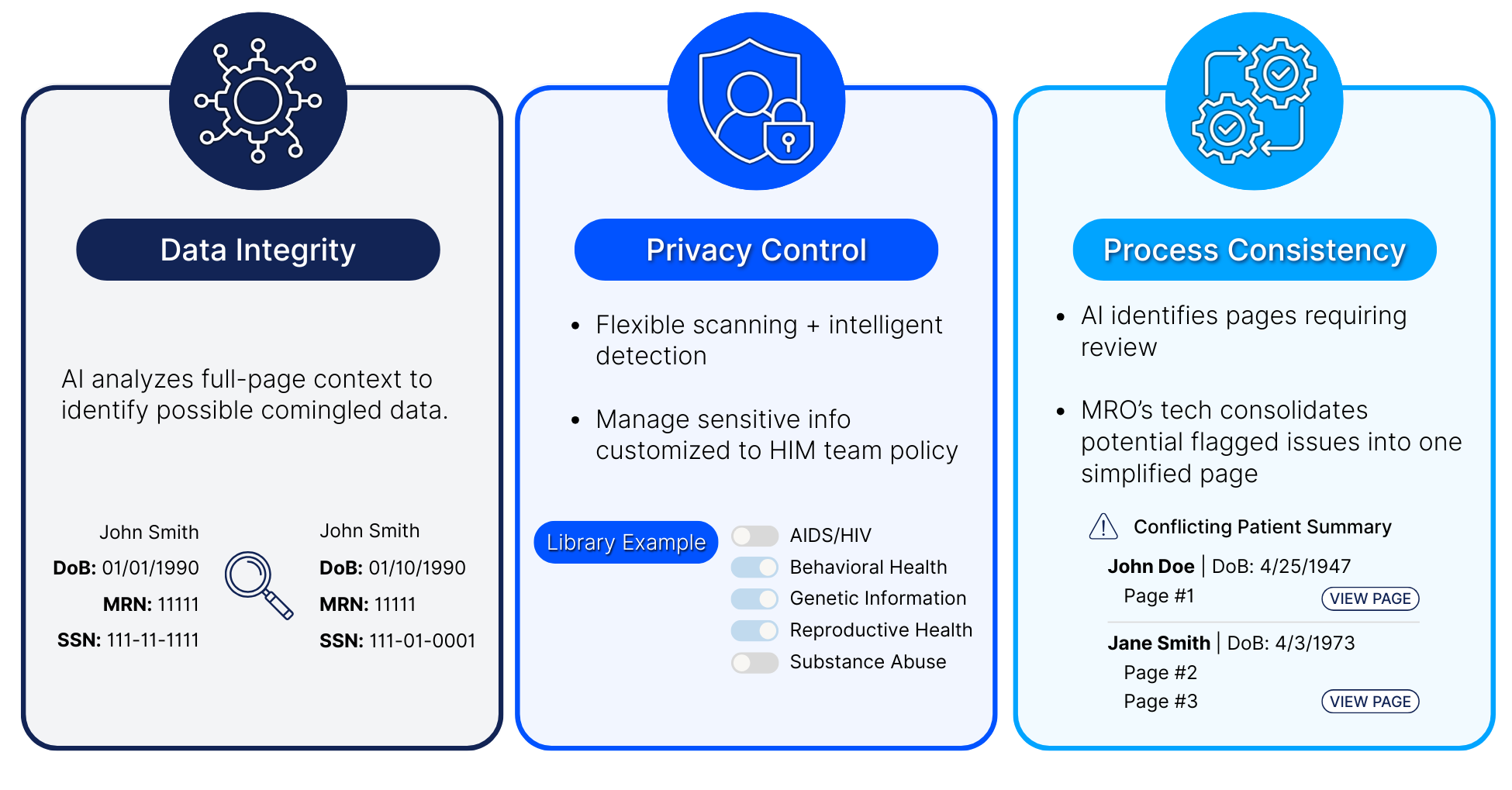
At MRO, we believe that leadership in HIM quality control requires more than just “we use AI”—it requires a clear architecture of capability, rigorous validation and a workflow-centric mindset. Below are three pillars that structure how we think about and deliver AI-enabled quality control.
Why this matters in today’s HIM environment
- Accuracy matters more than ever: When patient identity, demographics or full-record integrity are compromised, downstream impacts can include erroneous care, billing errors, compliance exposure or patient trust erosion.
- Turnaround time (TAT) is a differentiator: The faster and more reliably you can release valid records, the better you support care coordination, payer operations and patient access. AI-enabled quality control helps accelerate TAT while ensuring fidelity.
- Workflow-embedded intelligence beats bolted-on tools: Many competing solutions tout “AI screening” but still rely on heavy manual review, limited contextual analysis or disconnected quality control workflows. We believe the real frontier is tight integration of AI + workflow + review so Quality Management (QM) becomes native, not an after-thought.
- Modern AI reasoning transforms quality control: Unlike legacy automation tools that rely on rigid rules and narrow logic, today’s large language models (LLMs) apply contextual understanding, fuzzy logic, and adaptive reasoning to complex HIM scenarios. The latest models also leverage multimodal capabilities—the ability to interpret both text and visual data like charts, medical scans, and handwritten notes—these models offer a marked advantage in holistically detecting errors, validating record integrity, and reducing manual review across diverse formats.
- Governance, risk and audit readiness: With rising regulatory scrutiny over data integrity, identity matching and privacy, having an audit-ready framework that can demonstrate consistent quality control, detection of sensitive terms, and process analytics is a strategic asset.
- Scalability & standardization: Whether your organization is single-site or multi-facility, one state or multi-state, the need for consistent quality control performance across all sites is real. A centralized AI-quality control engine with configurable rules ensures consistency of output, no matter where records originate.
A leadership voice
“At MRO, our focus is to elevate the entire quality control lifecycle—from raw scanned pages through AI-based context review and into workflow-driven validation—so that our clients don’t just meet standards, they set them.” –Dave Costenaro, Lead Principal AI Architect
MRO is helping clients move from reactive quality control to proactive quality control—from catch‐and‐fix to predict-and-prevent. We believe this is the future of HIM-led information integrity.